Category Archives: Prose

Refuge

I was tired, and my family was most of the way through dinner when I walked through the door. I would have only an hour to spend with the kids before they would go off to bed. I joined them at the table, anticipating stories about the day. Instead, I heard complaints about what had been prepared for dinner. Shortly afterward, calls to clean up blocks and legos brought tears. Short voices from children and adults alike arose from attempts to complete homework that had waited too long.

I needed refuge.

I looked for it in the memory of the night before, when I had lain down next to my five-year old son after tucking him into bed. There had been a few minutes left before our usual lights-out time, and he scooted to make room as I moved the spare pillow up next to his. He noticed that his older brother was reading in bed, and sensing an opening to keep me right where I was, grabbed a book of his own. He asked me about each of the pictures in the book of trains and made comments about which ones he liked best. He came to the end of the book and glanced at me, perhaps expecting I would get up to say goodnight. When I didn’t move, he leaned over the edge of his bed for another book.

It’s Go Dog Go, Dad. I’ll read it to you.

I watched him as he concentrated, listened as he matched the words to the pictures, rescued him when a page was just too tricky. The wind chill blew well below zero outside, but the room was hushed and I felt warm in the embrace of my son’s company. When it came time to turn out the light, he reached for a sticky note on the floor beside his bed.

For a bookmark, Dad. We can start there tomorrow night.

And so tonight, as everyone’s dissatisfaction with the present moment was apparent, I was desperate to climb back onto his bed, find that bookmark, and pick up right where we had left off. We struggled through the rest of the evening routine as best we could, then he and I flopped onto the bed, our book right where we had left it. He propped up his stuffed Eeyore doll under his arm – to help him read, he said – as I retrieved the spare pillow at the foot of the bed. We settled back to where we had been the night before.

My refuge disintegrated.

His reading was halting as he struggled with almost all of the words. I grew frustrated when, line after line, he encountered the word around, yet he somehow couldn’t read it. The phone rang and the light didn’t seem quite bright enough for reading. To my dismay, nothing felt the same. Page after page, I wanted the world to flow just as it had the night before. My attempts to help, to give us both that little nudge, couldn’t turn the calendar back a day. Time was passing too quickly, and each page too slowly. We picked a place to stop and I stood up to turn out the lights.

As I kissed him goodnight and walked across the room to my other son to stroke his cheek, I rested briefly in my frustration – and finally found my refuge. Right where it had been waiting for me all along, in the Buddha nature of the moment as it was, in the Buddha nature of my sons, in the Buddha nature of disappointment. Not in the memory of a moment gone by.

Standing there in that moment, I knew that by reaching back to try and recreate the night before, I had been trying too hard to take refuge. That’s what the vow says, after all – I take refuge in the Buddha, I take refuge in the Dharma. Perhaps it is a relic of translation from ancient Pali, or maybe just an unfortunate semantic coincidence, but there’s nothing there to be taken. As if refuge were something that I could grasp or a place that I could go.

How many times have I gone down that path?

Refuge, instead, finally came from letting go, from an acceptance of what was already there for me. And while refuge can find foundation in a vow and in the great determination of Yuanmiao or Hakuin, it blossomed tonight in the suddenness of resignation, finding purchase in the ceasing, for just a moment, of longing for something more. In openness and softness.

Both boys were asleep within moments as I headed downstairs to stand with my wife at the kitchen sink, where the dinner dishes still awaited.

Let me rest 
against your extra pillow,
the embroidered one 
from your crib years gone by,

while you lean back 
amongst the blankets
and read to me.

Go ahead and ask me
what each page says,
and tell me,
in your right-up-close voice,
which ones
are your favorite pictures.

Scratch the turning page
against the flannel sheets
until the very last one,

then offer me another reprieve.

Reach down to your
old apple-crate bookcase, 
and murmur to yourself
about which book
you might choose next.
Winter Haiku #2

breathless light struggles —
long shadows arrive early
in the day’s passing

I feel like I’ve been writing around the edges recently. Circling around words that need to be expressed but aren’t ready to be committed. My notebook is littered with opening lines and untitled strings of paragraphs that don’t quite go together. This haiku managed to emerge complete, perhaps a part of circling inward. It is, in any event, one step next to another step, and what this moment holds.

No Merit

A scroll hanging in the entrance hallway at our Temple reads “No Merit”. It recalls the conversation of Bodhidharma, who brought Zen to China, with the Emperor Wu. When the Emperor asked Bodhidharma what merit he had accumulated through his support of monks and building monasteries, Bodhidharma replied: No merit.

One of my initial attractions to Buddhism was, in fact, the possibility of accumulation of merit, the idea that through diligent work in this life, I could earn merit that would propel me towards eventual release from suffering. The idea provided me concrete and tangible comfort from my fear of loss and annihilation. There was something I could do, after all.

And so Bodhidharma’s words and this idea in Zen initially came with a sense of loss. I came to the practice for the promise of comfort, because I thought (in an interesting connection to my family’s Puritanical roots that will someday make a separate topic for writing) that I could earn my way out of my fears. As the years go by, it doesn’t feel as much like a loss anymore, and more like an example of what simply is. No loss. No gain. Loss and gain. No idea.

I’ve been thinking about this tonight because two fellow bloggers have written to recognize this blog. Yesterday, hillbillyzen wrote to say she had nominated the blog for the Reality Blogger Award. And today, Linda at mayandseptember wrote to say she was giving a nomination for the Leibster Award. I know well that none of it makes me a better blogger or writer or more worthy of reading. But I think we blog because we’re interested in sharing what we think and notice and feel, but perhaps a lot of us (or, speaking for myself) don’t otherwise know exactly how. Recognition might mean that we have met our intention.

And so I will accept the kindness, badges or not, offered by hillbillyzen and mayandseptember (you should visit their blogs), and may try to recognize some fellow bloggers (perhaps in this space). As for the rest, I still don’t know how I feel about the whole process. Neither accepting, rejecting, nor ignoring the awards quite feels right. That not-knowing does feels just about familiar, though.

A Son’s Gift

As we turned the corner in the grocery store, my five year old son walked a step ahead of me, clear about where he was going and full of intention.

Making trips to the grocery store isn’t my favorite activity, and the number of cars in the parking lot told of a large crowd inside – but I didn’t mind making this Christmas Eve outing. As we drove to the store, I watched my son clutch the dollar bill that he had pulled from the old tea container on his dresser, preparing to contribute it towards his big brother’s Christmas gift. I listened to the assured way he spoke, without revealing everything to me, about what he had decided to give to him.

He marched confidently most of the way down the toy aisle and stopped. This one, he said, pointing towards the shelf. I followed the direction of his hand and saw the blue box of eight matchbox cars. He pulled it from the shelf with both hands, bringing it to rest against his winter coat as he examined it closely, then turning towards me as I caught up, hopeful I would approve his choice.

It was the same gift his brother had gotten for him the year before. The same gift he had loved. I remembered him opening it Christmas morning, how he couldn’t imagine his good fortune at receiving a box of eight new cars, all at once. What could speak more clearly of his love for his brother than wanting to reciprocate, a year later, with the same?

Yet, as I stood there with Robin looking up at me, all that ran through my mind was how to get him to choose something else. His brother True is seven and a half, and hasn’t played a lot with cars and trucks in the last year. I knew he would be gracious in receiving the gift, but it seemed an awful lot of cars if he wasn’t going to spend much time with them. And at $12.99, well, it felt like a lot.

Let’s look around, I said, see what else is here. I suggested the small Lego sets that were in the same aisle – True loves Legos, doesn’t he? I suggested card games and even some smaller sets of cars. Robin dutifully obliged and examined that the alternatives I offered, but his heart wasn’t in it, and I knew it. I could feel the way the big set of cars pulled on him, even as we stood at each different shelf, motionless. He dismissed all the other options without words and returned back to pulled the box off the shelf. As he did, I thought I saw my opening in the form of a box just behind, a sort of combination track and ramp for matchbox cars that could be set up from a table to send cars flying. He’ll go for that, I thought, as I pointed it out it to him.

He looked, but didn’t take long. No, he said, I want to get this one for him.

He wasn’t demanding – just trying desperately to show me his sincerity, sincerity born from the warm feeling that still lasted from the previous Christmas, and his desire to share that with his brother, to get him the perfect gift, just like the extra large box of tea he had picked out for his mother.

Every bit of me could see that, could feel it, yet for some reason still struggled against it.

You don’t want this? I asked, holding up the track again. You could have races to see which of the cars you already have goes the farthest. I tried to paint a different picture than the one he had composed, the one he was holding dear. No, he replied, this one. Don’t we already have those cars? I flailed. No, he pointed out, these are different. He’ll love these.

There was nothing left for me to say. I could have flatly said no, that the set was too expensive. Or told him I didn’t think True really wanted eight new matchbox cars. But I couldn’t do either.

So instead I did something worse.

Continue reading

Saving All Beings

I was very late coming home from work last night – it was after 11 o’clock, and the whole family was asleep. I thought for a moment, as my wife turned over when I entered the room, that she might be awake in our bed, but she was quiet and still by the time I joined her. And so when I awoke this morning, I was anxious to see them all. I knew that the kids would have to run off to school soon and I would have to return to work, but I looked forward to the short time we had as I walked down the stairs.

Which made it all the more painful when, minutes later, I took the box of cereal from my son’s hand as he poured it, and sent him away from the breakfast table.

I would tell you that I long for simple moments of being with my children, times when notions and expectations drop away. I had just such an opportunity at the table this morning, as my boys found themselves possessed by silliness – each look from one brought the other practically to tears from laughter. Their voices rose as they called to one another, taking turns making faces just subtle enough to hold the expression for the few seconds it took to send his brother back over the edge. Knees knocked against the underside of the table as cereal squares spilled and milk droplets dripped off of their spoons.

I had the opportunity to witness and join them in this playfulness, this joy. Instead, I found myself simply wanting it to end. My body pulled back, my breath quickened. They laughed. I tensed. I told them that it wasn’t time to be silly and reminded them about their table manners. I sent them away.

I suppose there are legitimate reasons to help my children shape good table manners; in our relative world, they are important. But what am I teaching them about their laughter? And it goes beyond the table. My boys’ joy often finds its expression in moments that are loud and frenetic, unconstrained by any adult’s ideas about how it should look or sound. As they laugh and jump, as they delight in any noise they can make, they are meeting the world, living fully in what is offered. Unfiltered. Present.

In receiving the ten Grave Precepts of Buddhist practice, I vowed, recognizing that I am not separate from all that is, I vow to take up the way of not killing. This precept is often applied to the choice of whether or not we eat meat, or how we respond to a mosquito in the bedroom. But it also speaks to asking my boys to calm and quiet themselves, to experience and express their joy differently than the way in which they have found it. What dies then?

In receiving the Pure Precepts, I vowed to save all beings. But when I ask them to be something different because their expression of themselves is impeding the quiet I was hoping for, what does my response mean to them? What do they make of that experience when the world presents something so real, and their father tells them it isn’t right – not right now, not right here?

What am I teaching them about their laughter?

Back at the breakfast table this morning, I sat alone and wanting the moment, like many before it, to be different. Not because it was too noisy, but because it had now grown far too quiet. I went and spoke to my son and asked him back, telling him I knew he could use his best manners while he finished his breakfast.

At dinner later in the evening, he told me that he had tried to buy a gift for me at the school holiday fair. It was a baseball bat that was engraved with World’s Greatest Dad. He had seen it the day before and brought his money into school. I looked at him in silence for a moment as he finished telling me the story, about how they had sold out by the time he got there. I asked him to come sit on my lap. He had trouble sitting still, as still as I would have liked after another long day at work. But you can’t always sit still when you’re busy saving all beings. Or at least your Dad.

Fatherhood and the Five Remembrances

As a part of our sutra service at the temple, we regularly chant the Five Remembrances. Intended by the Buddha to ward off an impression of permanence in our current existence, these ancient words remind us that we are of the nature to die, and that we cannot escape separation from those who are dear to us.

It is stark reality – but it isn’t while chanting at the temple that I feel the weight of this realization.

Last night, in the brief interim between the frenzy of the day and the full silence of night, my wife and I were talking about our children. I commented about the way in which our youngest son had greeted me when I arrived home from work. He ran to me with a stack of coupons he had cut out of a junk mail flyer from the local warehouse store. We stood in the middle of the kitchen, the table being set, the oven opening and closing, his brother and sister whirling around us. He wanted to sit right there, right then, and show me. Later on, I wondered aloud to my wife about what had held him there. Was it the coupons themselves that he was so eager to share? Was it his pride in the careful cutting? Or was it just the chance be together, no matter what was at the center of it or what was going on around us?

My son is always reaching into my back pocket, looking for my phone to take pictures. He takes snapshots of crayon boxes, books on the floor, our feet together on a stool, cookies cooling on the counter, and toy dragons on windowsills. Pictures of each room, doorway, lamp, and family member. Hundreds of them at a time. It clogs the memory on my phone, and we try not to have our kids spend too much time with electronics. But I always give in when he asks. Each time I hear the shutter click, I feel his joy and his presence in that moment.

So when he was perusing and clipping these junk mail coupons earlier in the afternoon, my wife remembered, he had paused when he came across a camera. Could I get a camera, he asked her. She replied that maybe he should put it on his Christmas list. She showed me how his eyes brightened as he offered, Or maybe I should get a phone.

I could see his face in my mind as my wife finished this story and as I walked toward the kitchen to make the next day’s coffee. I could imagine his deep pleasure at the idea of having his own phone with which to take endless pictures. I reveled, as I reached into the cupboard, in how much I adore him.

Then, in the time it took to pull down the box of coffee filters from the second shelf, the warmth of that adoration was swiftly swallowed whole by the remembrance of change. My change, his change. The remembrance that I am of the nature to die, of the nature to be separated from him. From everyone. From everything. The feeling sank deep into my gut, an impossibly heavy mixture of sadness, anger, and confusion.

Some say the words of the Five Remembrances help them to live in the present moment. I didn’t have the sutra in mind then, but I did make an effort to stand in the kitchen and accept all that was being offered, that koan pulling deep inside me. Mostly, it was a moment filled with wanting desperately to go and wake up my son, to watch him walk about taking pictures, then sit closely and talk about the ones we liked best. Would it matter how tightly I held him?

The Five Remembrances

I am of the nature to grow old.
  There is no way to escape growing old.
I am of the nature to have ill health.
  there is no way to escape having ill health.
I am of the nature to die.
  There is no way to escape death.
All that is dear to me, and everyone I love, are of the nature of change.
  There is no way to escape being separated from them.
My deeds are my closest companions.
  I am the beneficiary of my deeds.
  My deeds are the ground on which I stand.

The Lure of Accomplishment

My teacher often says that Zen is not a self-improvement project. And it isn’t. But it has changed me. I have noticed that I spend a lot less time planning my career, thinking about my degree, or fretting about how much money I’ll end up with. For that matter, I’ve pretty much let go of any idea of enlightenment beyond what I already have. Yet it seems that I still get caught up in trying to accomplish things – they’re just much smaller.

My mother stopped by on Sunday to spend some time with the kids. She and my daughter sat animated at the kitchen table, chairs pushed close together. They were piecing together a plastic cup, sponge, string, and some googly eyes, making a toy my daughter first made when she was she was five or six years old. If you wet the sponge, squeeze it tightly around and slide it down the string just so, it sounds an awful lot like a gobbling wild turkey.

(I am completely enamored of my daughter’s love for this sort of thing. She’s almost 10. I sometimes catch myself realizing that I expect her to be older by now, and that I’m so happy she’s not. But that’s mostly another story.)

This was just the sort of moment that I complain about not having the chance to witness or be present to. The possibility of being with my family, absorbed in something together, absorbed each others’ company. Except that I didn’t join them. I stood right there, leaning up against the butcher block counter, thinking about getting the lawn mowed one last time before winter, about getting the family budget balanced, about the need to roll out insulation in the attic and fix the broken glass in the window up there.

So much to accomplish.

There is real suffering in the desire for the moment to be something other than what it is, for it to be simpler. And there is a sense of impossibility in these moments, too. Graciously accepting what a moment has to offer could mean dropping away my own concerns and being fully present with my wife or child. But it also must mean accepting the part if me that feels the conflict, that part that is pulled away by a nagging mind wanting to do and to accomplish. In the world of emptiness, one isn’t better than the other. In the world of form, of fatherhood, of the kind of impermanence that means childhood years are short, I sure know which one I prefer.

For all of the regret that I might muster on my drive to work or in the quiet hours after bedtime, though, that moment in the kitchen has already passed. Zen practice is very reliable in that all that it asks me to do is to sit down. Perhaps there is no answer to the lure of accomplishment, either, but to sit down – or stand up, or run around – and play when someone comes asking. The small change may come. Or it may not. But I’ll be there.

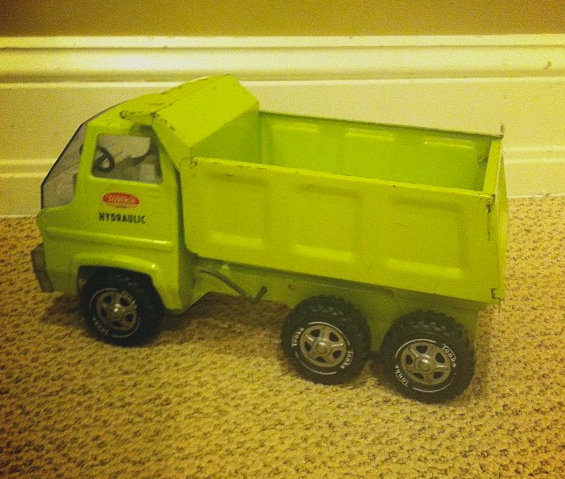
Big Trucks


My daughter went to see the nurse at school yesterday, not feeling well, and she came home early. I wish I could have been there for her. Not because she needed me – her mother was there for her – but because it was a moment that I missed. I would have loved that hug.

Even though my wife teases me that I wouldn’t be able to manage all the day-to-day muck work that she does – and I think she’s right – I’m jealous of what she gets to witness. I would love to be there for the game of crazy eights with our five year old after his older siblings have gone off to school, for the trip to the library after school to see all three of them pore over books, for the trips to the pediatrician to watch them have their reflexes tested.

Monday morning, a holiday, I took the boys to Home Depot to buy concrete for a basement project. I bought new filter masks for them so they could help without filling their lungs with fine portland cement, and we came home and poured concrete. They poured the water and acrylic fortifier, talking eagerly about which one they liked best. Look at the concrete dust, they said, fully aware, fully present. Meanwhile, not wanting the concrete to set, I spoke too quickly to them as I moved in the tight spaces.

Continue reading

Copper Pots

For a few years in my early twenties, my father gave me a piece of copper cookware every once in a while. Cooking was one of the ways we managed to connect, and the pieces were beautiful. And they were substantial. Weighty. As long as I took good care of them, they would last forever. I imagined I was building a permanent collection. I was building my life.

Over time, copper develops spots, and if you scrub it with regular soap and a sponge, it scratches quite easily. Instead, you have to use special cleaners and stay diligent about keeping up with them. My wife and I have occasionally fallen behind in this task, especially when we run out of the cleaner, which never rises quickly back to the top of the shopping list. After only a use or two, the pots begin to turn a mottled, and then even dingy, brown and stop reflecting the light of the room.

Eventually, though, some space opens in the time we have after a meal, and we get back on the bandwagon and clean the pots. But lately I’ve begun to wonder why we do it. Yes, they’re beautiful. And they might just last forever, or least for hundreds of years. But I’m not going to.

I do keep washing. There is something quite pleasing about the task itself, in the possibility of absorption in the water, the shine of the metal, the repetitive circular motion. Each time, though, what I hold in my hands feels a bit more like just a pot.

Zoe & A Boy

I can remember my body shaking the same way when I was a boy. My lungs trying to pull air back in, but the convulsions from my crying making each breath stutter and pushing air back out. I can remember feeling that I shouldn’t be this way, that I should stop as soon as I could.

I saw this happening to my son as we stood in the rain of Hurricane Sandy, digging a final resting place for Zoe, our cat who had passed the night before. I searched for ways he could help, but between the rocks in our New England soil and the roots from the Hemlock tree above, the digging was achingly slow – and too much for seven year old arms. But he had asked to help. And so he stood there, steadfast, arms at his side, dripping, as my crow bar and shovel made slow work.

He doesn’t often stand so still. He’s much more likely than his older sister or his younger brother to be a blur, volume pegged high, childhood silliness taken one-half step too far. The kind of exuberance that some people label as “a boy being a boy” – the kind that looks like he’s moving way too fast to possibly stop and think, or to stop and feel.

But he simply stood there, clearly thinking and feeling. Not completely still, because he shook, just as he’d done the night before after the vet had come to the house and gone, and he had asked me to read a story. Sure, I said. Maybe a Pooh story, he asked, meaning one out of our vintage A.A. Milne hardcover that has long since had its binding completely loosened by overhead reading, and cover marked in crayon. Pooh wasn’t his usual choice, at least not since he willed himself to be enough of a reader to catch up to his older sister in reading Harry Potter. But I read, and he laughed with sincerity, as any child will do if you read them a Pooh story with all of your own sincerity. As he finally got into bed, though, the gaiety of those stories fell to the pain of his first loss. His bravado, which compels him to be faster, stronger, or funnier than all comers, which would have him best his four year-old brother by any means, that bravado fell too. And he didn’t stop shaking for a long time.

I told him in that moment that this is what makes him special. I told him his sadness, the way he lets himself feel it, is what make him a good son, a good brother, and why Zoe loved him so much. It’s more than okay for you to feel this way, I told him. It’s what makes you who you are. It’s your gift.

Back in the rain, after more struggling with the New England soil, we had gone in to get the rest of the family after the hole was finished. He almost didn’t come back outside. But he remained desperate to help, not knowing how much he already had by standing at my side. He ached to feel the connection he needed, as much as it hurt. And so he took the cardboard box containing Zoe’s body from the barn as we walked toward the back of the yard. It hardly weighed anything at all, but looked so heavy in his arms as the rain splattered its top. His effort, I think, was in his heart and in his lungs drawing in air, and perhaps in staring straight ahead.

We reached down and filled the grave with the box. Shortly, his brother and sister walked back toward the house. But he stayed and helped me begin to add back the dirt. Then he simply stood again, still and soaking. Still and soaking and thinking.

Until he spoke. Can we mark it, Dad? What will we use to mark it? I’ll get a flat rock, I replied, I’ve got a few on the stone wall. It has to be at least three feet tall, he said with plain conviction. Three feet, I asked, why three feet? Well, he said, the snow can get up to that deep.