Tag Archives: fatherhood

Mother’s Day Tea

Last Thursday, my son woke up early and called to me in his still-morning voice, Daddy, this morning at eight forty-five is Mother’s Day Tea!

It is unusual for him to be excited about something like a Mother’s Day Tea. Special events tend to bring out what shyness he has, and he is not nearly so keen as his older brother on wearing a collared shirt and tie. But sure enough, he had even picked out a special sweater to wear and laid it on his bed.

My wife has been to a lot of these Mother’s Day Tea events over the years as our children have attended the same preschool in turn. Our youngest son is now five and starts kindergarten next year. This year’s Mother’s Day Tea was the last.

Later that same afternoon, I sat with my son on his bed while he showed me some of his new library books and told me about the cookies he had at the tea. He had changed out of his formal shirt and tie and was wearing a dark blue t-shirt emblazoned with pictures of different small whales and the words Nos Amis les dauphins. I love this shirt, and like our preschool and annual Mother’s Day Teas, all of our children have passed through it. One day soon, though, there will be a final wearing as our youngest grows out of it.

We don’t have another child to grow up and go to the next Mother’s Day Tea, or grow into the dolphin shirt. This realization has been arising much more frequently lately, and usually with it the impulse to turn my head to the side and close my eyes, as if turning away from something I would rather not witness.

At first, I was upset with myself for feeling this way. I would take it as an indication that I wasn’t living in the moment. I would scold myself for not being fully present with my children and instead worrying about how we would change as they grew older. Yet as I sat with my son on his bed that afternoon, my deep sadness about this phase of my life changing and receeding was quite real, very much the essence of the moment.

If Zen has begun to teach me anything, it is that the present moment encompasses all of my experience – all of the universe. This includes the desire not be in that moment, or the wish for it to go on forever, despite being fully aware of its impermanence.

I started out my spiritual searching looking for, desperate for, something that would make everything all right. I’ve come to realize, though, that everything isn’t all right – at least not in the way I had hoped.

There was something exquisitely joyful about those moments with my son. And something painfully sad, too. But all of it is my life. The deep intimacy of my life with my children, and the loneliness that comes from knowing we are all of the nature of change. All of it.

Recognizing and being grateful for all of that, that’s what might be all right – and maybe, just maybe, what I have been longing for.
Entwined

Passing quickly in the morning
as you make lunches
and I rush to the car
isn’t what I imagined

that day we stood
in the old barn by the sea,

my hand gently touching yours,
and feeling every movement of the sweat
trickling down the small of my back.

Standing outside in the garden,
I didn’t notice the photographer
as we talked idly
between silences
about the softness of the rain —

though the pictures in the crimson binder
tucked up on the highest shelf
tell me he was there.

Let’s meet again in that garden,
where we can stand still,

my hand resting
on the laces that entwine
the back of your dress.

Touching the Heart Mind

Later today I will drive to the Temple in a likely swirl of emotions. I will leave my family behind for a four-day retreat, an opportunity that is a great gift. Yet I will be driving away from goodnight kisses, baseball and t-ball games, and chalk drawings on the driveway. Away from faces asking me why I have to go. I’ll leave behind my wife to pick up these pieces with grace and great generosity.

Sesshin, the name for extended retreats in Zen, translates as touching the heart mind. When I returned home from an eight-day sesshin last summer, the weight of this touching was almost too much to bear, too much to express. I wrote these words for my wife:

opening the door,
seeing each of you,
touching each of you,
tears not from missing you
[though how I did] --

but rising from a heart
once, twice, innumerably papered over
by each and every part
of our rushing lives.
a heart stacked upon
by ten thousand necessities
pressing down
on a space deep inside.

a heart now broken
open
so that the tears
streaking down my cheek
contain my whole life,
falling onto the rise of your shoulder.

Last Light

I know the first hints of leaves
are the lightest green.

Yet they appear black
against the wisps of clouds
and a sky growing pale
just before darkening.

He comments on them
looking up from his bed,
and asks to leave the curtains open.

It sure is nice light, I reply
and stroke his hair.
His stillness is perfect
even as he turns his head
for me to brush his other cheek.

A father and son will argue sometimes —

but the morning and its disappointment
are forgotten
in the last light
of this day.

Spring Haiku #1

deep night rain hammers
outside on the old tin roof —
blossoms arising

I drove home from work after midnight last night. It was my son’s eighth birthday. The cake from his celebration that I had missed sat half-eaten on the counter, surrounded by cards from his grandparents.

I haven’t had the time to capture poems and words lately, even as small snippets of them have run through my mind, my days. As I crawled into bed next to my wife last night, I heard the spring rain outside. For a moment, clarity.

Ten

Her ears glowed bright red
when she returned home,
newly pierced earrings
gracing either side of her
bright eyes and shy smile.

I wished that we had taken her picture
in the morning,
but we hadn’t planned
for this to be the day —
just gone ahead when she asked,
following through on a months’ old promise.

As I watched her through the kitchen window
my wife told me about how
brave she had been.
We reminisced about that cold winter
when we had walked her back and forth
between her bedroom and ours,
soothing her newborn tears.

She came inside to tell me
she had seen the first snow drops,
or at least their green shoots
peeking through the icy leftovers
of the latest storm.

That’s where I’m going to build my fairy house,
she told me.

She ducked back outside
and leaned against the post on the porch,
filling an old seashell with greenery,
her legs outstretched
in the pale sun and
whispering quietly to herself,
perhaps about the moment,
or maybe about
all of her ten years.

(A found companion piece to Almost Eight)

Coloring a Sunny Day

photo

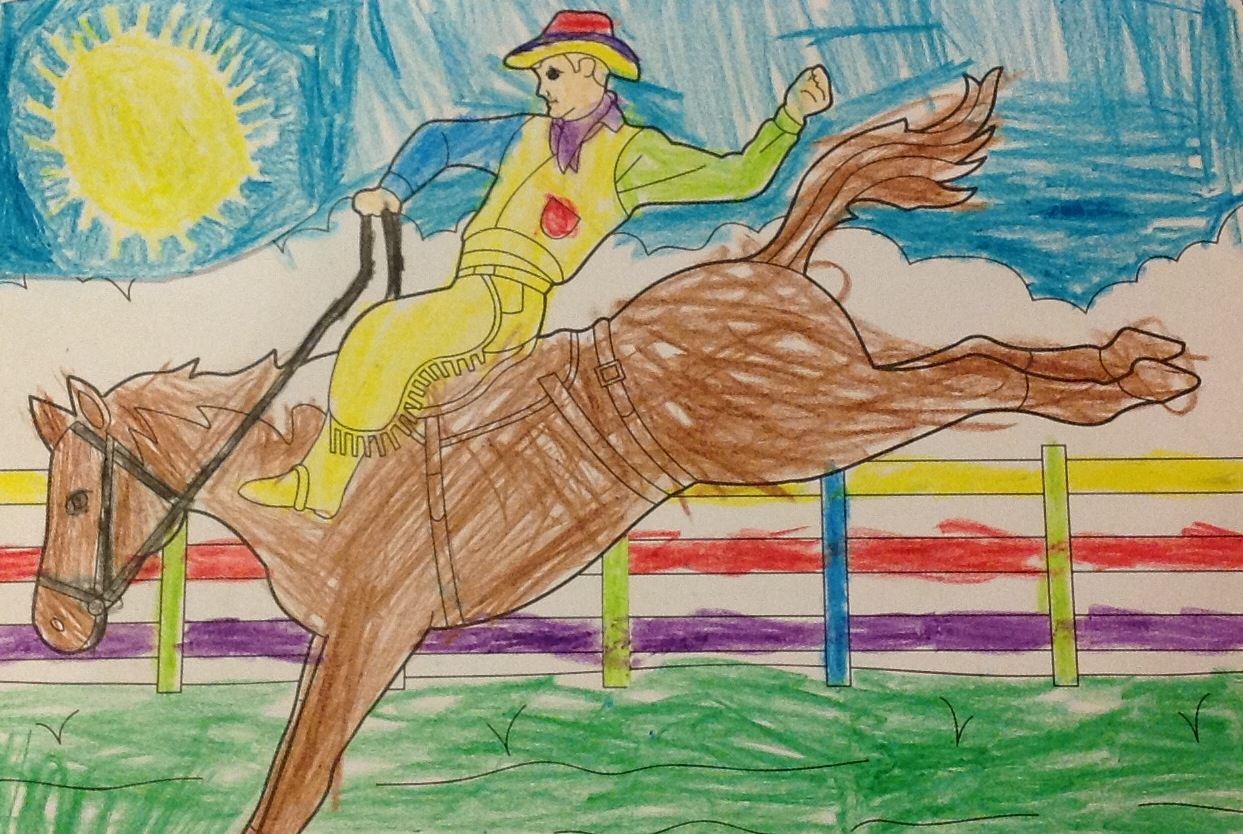
Recently, our youngest son discovered a couple of large coloring books that had been tucked away on some basement shelves, unused since we got them years ago. He has sat with them several times for long stretches, simply coloring, tongue planted in his cheek just the way mine was as a boy when I was deep in concentration.

One afternoon this past weekend, he cleared some space at the kitchen table and asked me to sit with him while he colored. He chose a scene with a cowboy riding a horse, and worked carefully in crayon to make a sun in the corner of the page, complete with rays spreading out from a bright yellow center. I watched as he then colored a large swath of the sky, coloring blue right over the yellow sun. I wondered if he intended it that way, or if he was just caught up in the enjoyment of the blue. The answer came a moment later when I noticed him take a black crayon and make a scribble over and over the sun, and then slump back in his chair, dropping the crayon to the ground.

I thought this would fix it. It was supposed to be yellow, he said staring down at the sun, but I did the blue on it. I thought this would make it back to darker yellow, but it just ruined it.

He exhaled deeply and looked at me, then half-heartedly scraped with his thumbnail at the blue and black that covered his sun. The contentment that I had felt in sitting with him faded into sharing his deep disappointment.

What if we make it a cloud? I asked. It was the only thing I could think of.

Okay, he said.

I picked up the black crayon and traced an outline around the sun. There, now you color it in, and it will be a nice dark cloud.

He took the crayon from me and did just that. The black cloud looked a bit out of place in the otherwise bright blue sky, but he picked up a brown crayon and went back to coloring the cowboy riding his horse. I quietly exhaled in measured relief.

Until he started to cry.

But I wanted it to be a sunny day, Dad.

I was completely and utterly helpless. He had been enjoying our moment as much as I had; I was sure he had been enjoying the idea of his picture too, the image of it he held his mind. Now neither one was the way he wanted it to be, and there was nothing I could do about it.

Remembering his attempt to scrape away at the crayon, I thought of getting my wife’s sharp pair of sewing scissors to do the same, to reduce that paper to white, to give my son the fresh start he wanted.

Perhaps it was the scissors that gave me the idea of drawing a new sun on a separate piece of paper and pasting it on top of the mistake. I wasn’t sure he would like the idea, but he agreed and drew a new sun on a white piece of paper. He asked me to color in the blue so he wouldn’t go over the rays. I worked carefully and then had him finish before we glued it on. He was happy with it, and went back to the cowboy, the grass, and the fence.

Even though it turned out all right in the end, I can still hear him saying to me, through his sobs and tears, But I wanted it to be a sunny day, Dad. He had tried to set aside his disappointment – but he couldn’t. Instead, he surrendered to complete presence in the moment. No pretense, no holding back, no self-judgment. Isn’t that what we all long for?

Most touching as a father is that my son was willing to do this with me, and in this way expressed his complete love and trust. As an adult, experiencing and expressing anger, sadness, or disappointment in the presence of others is difficult for me. I have come to fear doing so.

Yet here was my five year old, showing me exactly how to do it right here, right now.

But I wanted it to be a sunny day, Dad.

Coda: In the days since, I have thought a lot about having fixed the drawing. I know I won’t always be able to give him the sunny day he wants. And I shouldn’t. But this one? I had to.

A Long-Forgotten Toy

Outside a robin hops
from a crusted snow pile
to the matted spring grass.

I stand at the window and watch,
while the echo of quiet play
mixed with soft humming
drifts out of the nearby bedroom
and into the hallway,

coming from a son
who is supposed
to be getting dressed —
but who has found absorption
in a long-forgotten toy.

I wish I could move
to see him,
but I don’t dare
stir the light
or sound the floorboards.

My body is warmed by the sun

before a shouted question
from downstairs intrudes
and the moment drains away.

Almost Eight

I stopped at the top of the stairs
to wait for him
as he shuffled out of his bedroom,
sleepy-eyed and not yet steady.

He took the old walnut railing
with his left hand
as we walked next to each other
towards breakfast and the day.

His right hand reached into mine,
gentle and soft,
warm from his blanketed slumber.

He’s almost eight years old, I thought,

in fear of the day
when he won’t slip so easily
into sharing his space
or his hand
with me.

I tried to tread carefully as we went
so as not to disturb our clasp,
wishing the stairs might go on forever,
a father and his boy.

The Spiral and The Path

DSC_0354_a
 
The fist time I made the spiral, I didn’t do it on purpose.

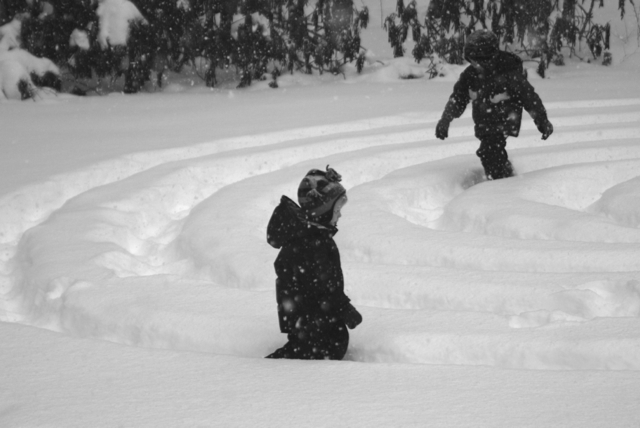
A few winters ago, I ran into the backyard after the first snow, and kept going until I had left a path of ever-smaller concentric circles. As will happen with snow, the path remained, and I walked back out along the same way. The kids, much younger then, noticed the design and enjoyed walking on it, too.

As much as being made of snow meant that the path wouldn’t disappear immediately, it eventually faded and was replaced by spring grass and flowers. Yet winter returns each year, and I anticipate the moment on the morning of the first snow of the season… Can we make the spiral, Dad?

Most years, subsequent snows pile on top but leave the pattern discernible underneath, and we walk it over and over to freshen the path to the inside. Other winters, the first snow melts away before the second one comes, and we have to remake the spiral several times over the course of a season. The kids will comment as the spiral disappears, You can still see it…but it will probably be gone by tomorrow.

A few years ago the snow was relentless, its crushing weight on the roof creating dams of ice that forced leaks into our nineteenth century windows. Over and over, I spent hours hours on a ladder, dangling precariously twenty-five feet up, spraying steaming hot water from a hose, melting away the damns. I would climb down the slippery ladder, encased in ice and exhausted, knowing the process would only have to be repeated in a few days time. The inner point of the spiral provided a respite at the end of this work; sitting seiza style in the bitter cold became easier than inside on my maple bench by the heater.

A couple of weeks back, my boys were running through this year’s spiral. We had recently gotten nearly three feet of snow in a storm, so it was tough going even though I had made the path smooth with snowshoes. The boys kept tripping and falling, laughing and shouting.

Be careful, I called.

That three feet of snow, of course, meant that I needn’t worry about them getting hurt. That would be impossible, and wasn’t why I had warned them to be careful. Instead, I was concerned about damage to the spiral.

Be careful.

The absurdity struck me before I finished saying it. The spiral comes and goes with the season and with the weather; it is the definition of impermanence.

Standing there, I knew the undisturbed edges and smooth path of the spiral aren’t real. They are simply my preferences, and aren’t likely to change anything, or to survive the transience of a path made out of snow – or survive the transience of this self I have grown attached to.

The spiral is beautiful after a fresh snow, when its lines are smoothed out. Just like my life, though, the spiral changes form, is disturbed, is re-created over and over, and inevitably disappears. Does it matter if it succumbs to a soft April morning or to my boys’ exuberance?

Buddhism and Zen urge us to practice renunciation, but this isn’t all about giving away our property or joining a monastery. It means letting go of preconceived notions and thoughts, of attachments to the ways we wish things were.

Like the spiral.

Letting go of the spiral, in fact, may open space to be more intimate with the path that is here today, right now. The one where my boys are tripping and falling, laughing and shouting. The one I am walking with my wife, with our children, the one with the rough edges and the sunshine, the snow and flowers, the sticks and the mud.