Tag Archives: parenting

The Lure of Accomplishment

My teacher often says that Zen is not a self-improvement project. And it isn’t. But it has changed me. I have noticed that I spend a lot less time planning my career, thinking about my degree, or fretting about how much money I’ll end up with. For that matter, I’ve pretty much let go of any idea of enlightenment beyond what I already have. Yet it seems that I still get caught up in trying to accomplish things – they’re just much smaller.

My mother stopped by on Sunday to spend some time with the kids. She and my daughter sat animated at the kitchen table, chairs pushed close together. They were piecing together a plastic cup, sponge, string, and some googly eyes, making a toy my daughter first made when she was she was five or six years old. If you wet the sponge, squeeze it tightly around and slide it down the string just so, it sounds an awful lot like a gobbling wild turkey.

(I am completely enamored of my daughter’s love for this sort of thing. She’s almost 10. I sometimes catch myself realizing that I expect her to be older by now, and that I’m so happy she’s not. But that’s mostly another story.)

This was just the sort of moment that I complain about not having the chance to witness or be present to. The possibility of being with my family, absorbed in something together, absorbed each others’ company. Except that I didn’t join them. I stood right there, leaning up against the butcher block counter, thinking about getting the lawn mowed one last time before winter, about getting the family budget balanced, about the need to roll out insulation in the attic and fix the broken glass in the window up there.

So much to accomplish.

There is real suffering in the desire for the moment to be something other than what it is, for it to be simpler. And there is a sense of impossibility in these moments, too. Graciously accepting what a moment has to offer could mean dropping away my own concerns and being fully present with my wife or child. But it also must mean accepting the part if me that feels the conflict, that part that is pulled away by a nagging mind wanting to do and to accomplish. In the world of emptiness, one isn’t better than the other. In the world of form, of fatherhood, of the kind of impermanence that means childhood years are short, I sure know which one I prefer.

For all of the regret that I might muster on my drive to work or in the quiet hours after bedtime, though, that moment in the kitchen has already passed. Zen practice is very reliable in that all that it asks me to do is to sit down. Perhaps there is no answer to the lure of accomplishment, either, but to sit down – or stand up, or run around – and play when someone comes asking. The small change may come. Or it may not. But I’ll be there.
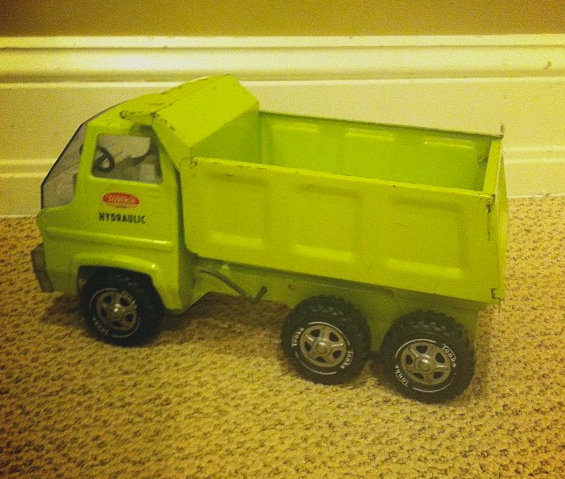
Big Trucks


My daughter went to see the nurse at school yesterday, not feeling well, and she came home early. I wish I could have been there for her. Not because she needed me – her mother was there for her – but because it was a moment that I missed. I would have loved that hug.

Even though my wife teases me that I wouldn’t be able to manage all the day-to-day muck work that she does – and I think she’s right – I’m jealous of what she gets to witness. I would love to be there for the game of crazy eights with our five year old after his older siblings have gone off to school, for the trip to the library after school to see all three of them pore over books, for the trips to the pediatrician to watch them have their reflexes tested.

Monday morning, a holiday, I took the boys to Home Depot to buy concrete for a basement project. I bought new filter masks for them so they could help without filling their lungs with fine portland cement, and we came home and poured concrete. They poured the water and acrylic fortifier, talking eagerly about which one they liked best. Look at the concrete dust, they said, fully aware, fully present. Meanwhile, not wanting the concrete to set, I spoke too quickly to them as I moved in the tight spaces.

Continue reading

Zoe & A Boy

I can remember my body shaking the same way when I was a boy. My lungs trying to pull air back in, but the convulsions from my crying making each breath stutter and pushing air back out. I can remember feeling that I shouldn’t be this way, that I should stop as soon as I could.

I saw this happening to my son as we stood in the rain of Hurricane Sandy, digging a final resting place for Zoe, our cat who had passed the night before. I searched for ways he could help, but between the rocks in our New England soil and the roots from the Hemlock tree above, the digging was achingly slow – and too much for seven year old arms. But he had asked to help. And so he stood there, steadfast, arms at his side, dripping, as my crow bar and shovel made slow work.

He doesn’t often stand so still. He’s much more likely than his older sister or his younger brother to be a blur, volume pegged high, childhood silliness taken one-half step too far. The kind of exuberance that some people label as “a boy being a boy” – the kind that looks like he’s moving way too fast to possibly stop and think, or to stop and feel.

But he simply stood there, clearly thinking and feeling. Not completely still, because he shook, just as he’d done the night before after the vet had come to the house and gone, and he had asked me to read a story. Sure, I said. Maybe a Pooh story, he asked, meaning one out of our vintage A.A. Milne hardcover that has long since had its binding completely loosened by overhead reading, and cover marked in crayon. Pooh wasn’t his usual choice, at least not since he willed himself to be enough of a reader to catch up to his older sister in reading Harry Potter. But I read, and he laughed with sincerity, as any child will do if you read them a Pooh story with all of your own sincerity. As he finally got into bed, though, the gaiety of those stories fell to the pain of his first loss. His bravado, which compels him to be faster, stronger, or funnier than all comers, which would have him best his four year-old brother by any means, that bravado fell too. And he didn’t stop shaking for a long time.

I told him in that moment that this is what makes him special. I told him his sadness, the way he lets himself feel it, is what make him a good son, a good brother, and why Zoe loved him so much. It’s more than okay for you to feel this way, I told him. It’s what makes you who you are. It’s your gift.

Back in the rain, after more struggling with the New England soil, we had gone in to get the rest of the family after the hole was finished. He almost didn’t come back outside. But he remained desperate to help, not knowing how much he already had by standing at my side. He ached to feel the connection he needed, as much as it hurt. And so he took the cardboard box containing Zoe’s body from the barn as we walked toward the back of the yard. It hardly weighed anything at all, but looked so heavy in his arms as the rain splattered its top. His effort, I think, was in his heart and in his lungs drawing in air, and perhaps in staring straight ahead.

We reached down and filled the grave with the box. Shortly, his brother and sister walked back toward the house. But he stayed and helped me begin to add back the dirt. Then he simply stood again, still and soaking. Still and soaking and thinking.

Until he spoke. Can we mark it, Dad? What will we use to mark it? I’ll get a flat rock, I replied, I’ve got a few on the stone wall. It has to be at least three feet tall, he said with plain conviction. Three feet, I asked, why three feet? Well, he said, the snow can get up to that deep.