Tag Archives: sons

Almost Nine

Today is the final day he is almost nine.
As I worried he might,
he holds my hand less often.

The world pushes in on us;
the spaces in which we can hide —
just the two of us —
are more difficult to find,
simpler to disrupt.

Yet on this day,
his brother and sister
already gone from the table,
he pauses at my shoulder.

Even as I pull him onto my lap,
I expect him to continue on
to his book or simply something else;

but he sits
and softens.

Later, in the quiet of a too-late night
my wife whispers to me,

you should have seen his face.

Newest poem in the Years series.

Keep Me Company

Winter’s early cold has gathered
steam against the windows,
softening the lights’ reflection.

Standing in the doorway,
I strain above the hum of the dryer
to hear my son
as he narrates his play by whisper
in the old claw foot bathtub.

I should be helping him,
but he hasn’t noticed me there,
and the teacup is warm in my hands.

Finally he stills and calls to me — Dad?
I thought you were going to keep me company?

Of course I am.
Of course I am.

At the Small Table

When I catalogue my regrets
at the end of the day,
I won’t include the moments we spent sitting
at the small table in the living room.

The old-fashioned fire whistle,
remnant of summoning volunteers
across the town,
punctured our long silence —

you picked up your head only briefly
from the sea-blue magic marker
before returning to your work,
tongue pressed in concentration
against your cheek.

We laughed gently about
a pair of dogs we could see
through the window
and across the street
jostling in the slanted afternoon sun.

You asked me not to leave —
yet there was never any chance;
my movement only a reach to the floor
for the morning’s leftover mug and a
sip of luke-warm coffee.

How the Children have Grown

He means well and offers connection
when he remarks how the children have grown,
that it won’t be too long before they aren’t around.

My daughter blinks her eyes
while my son mouths to me that
it isn’t true.

My own sense of the truth of his words
doesn’t make them welcome in the moment
of which they are now an indelible part.

Pride, Love, and Putting the Bucket Down

I was never more proud of my son than I was that day, just a few weeks ago. Thank goodness that has worn away, so I can keep loving him for who he is.

My wife and I have been working on a landscaping project at the house, converting a thousand-square foot area from grass to perennials and herbs. Grass never grew well in this south-facing area, and I am excited about having even more fresh flowers to cut in future years. As a part of the project, I decided to replace a section of fence with a dry stone wall and to install a border of paving stones between the driveway and this new garden.

A couple of weeks back, the day’s work involved digging a trench for the pavers, sixty feet long and about a foot wide. Being next to an old asphalt driveway laid on top of New England clay soil, there wasn’t much easy digging. As I went, I worked to save the small rocks that came out of the ground, since they would make good fill around the base of the stone wall. This meant sifting out the dirt and sorting the stones into different piles. One foot at a time, on a very warm August Saturday.

My son shuffled towards me relatively early in the day. Can I help, Dad?

I thought for a second about what he might be able to do. My initial reaction was that he wouldn’t be able to help. The pick axe is too heavy for him, I thought. The weight of stones themselves, while small, would add up quickly, and they needed to be piled a good fifty feet from where I was working. The wheelbarrow is too big for him to manage.

Sure, I said, still thinking. Go get a bucket, one of the big ones. And put some good shoes on.

Continue reading

No Need to Pretend

A co-worker and I stood in the office kitchen this morning as she searched for a spoon. We joked about how she might eat her cereal with a fork, how it might be easier if it were cereal and yogurt. My voice was clear and my laughter sounded easy. But my heart was somewhere else.

What is the toll, I wonder, from laughing, from pretending and projecting that all is well, when the reality is something different?

My wife and kids have been away for a few days, visiting family now that the school year has ended. I stayed home, with a few meetings this week that I could not miss. Last night I returned home close to midnight after one of those meetings and went out to close up the barn. Five of our six chickens were perched up on their roosts, with the sixth lying very still and awkwardly on the floor. I propped her up on some fresh hay for the night, but this morning she was less responsive and clearly dying. By now, she’s certainly passed.

My son was devestated this past fall when we lost our cat, a dear member of the family who the kids had grown up with. I was so deeply moved by his reaction as we buried her that a story poured out of me that night; that story became the inspiration for this blog.

The chickens were a present for him for his eighth birthday in April. He said it was the best birthday present ever.

I grew up raising chickens, along with sheep and rabbits. I remember the first spring flock that I was responsible for, and my dismay when we lost most of them to an intruder in the coop, likely a fox. I like to tell people that growing up around animals was a good experience, that I learned at an early age about caring for others, about life and death. My original Tibetan Buddhist practice, too, spoke of the value of coming to understand death as a part of our lives.

I’m not so sure this morning about either of those stories.

My son will come home today and learn about this new death. I’ll want to make everything all right for him, knowing at the same time that is not possible. I could look at this experience as a gift. But it’s hard. And what will I do when the death in our lives is closer?

I can’t share any of this with the people around me. I move around the office pretending that this is just another day. I pass by co-workers and talk jovially about this and that.

A little while ago I closed the office door to call my wife and let her know about the chicken, what is awaiting her at home. In the course of that conversation, I learned that the emails I have been sending to her over the last few days, reaching out to make a connection, have gone to an account she can’t access away from home. I hung up the phone feeling more isolated, then went to sit in a meeting and discuss the ramifications of the end of the fiscal year.

I didn’t realize it when I began, but my spiritual practice has taken shape as an effort to drop pretense, to live my life as it presents itself. In some respects, I have begun to realize this through Zen. At the Temple I can sit wth the complexity of fatherhood, marriage, love, joy and sadness, or share with a friend in the sangha after the evening practice has ended. I’ve been striving to do this at home too, with my wife and children, and it has allowed me to experience both joy and sadness more fully, more intimately.

At the same time, I am more accutely aware now of the places and times that I cannot. I worry about the cost.

When I get home this afternoon, I’ll hold my son and tell him it is okay to wonder why this has happened again to an animal he loved. I will tell him it is all right to be sad, to cry, to deeply feel whatever arises. I’ll tell him there’s no need to pretend.
Five

The arc on the old swing is short
and the set rocks uneasily
from so many seasons
in the snow and rain.

He has known it
for all of his five years,

but now runs to it less often,
lingers not as long.

Just the other day
he asked me for a push,
one he doesn’t need anymore —
a big one, he said,
and laughed
as he rose and fell
straining back,
reaching upward.

The blue sky was clear
and closer than it used to be.

Completing the set with companion pieces Ten and Almost Eight.

Laugh with Me

FathersDay
 
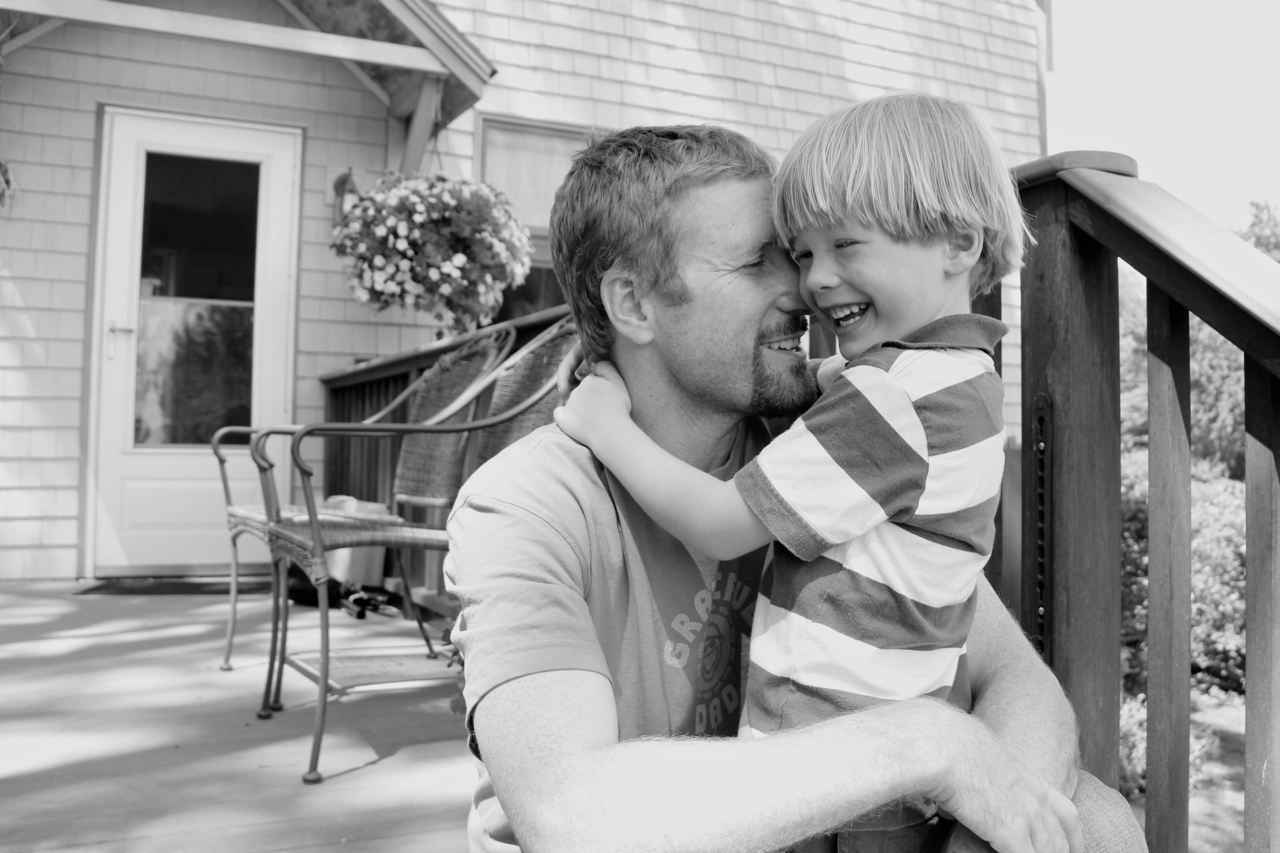
Come close to me, son,
together in the morning air

and tell me
with just your smile
your eyes and your hands
that you love me.

Laugh with me,
rest your cheek close to mine,
and I will tell you too.

Dukkha and the Essence of Fatherhood

A few years ago I attended the funeral for the father of a good friend and colleague. My friend’s father had been an important public figure, serving as a Justice on the state’s Supreme Judicial Court. Many speakers at the service described his important contributions to civic life.

When my friend stood up to speak and remember her father, though, she talked about dinner. While her father held an important position, she noted, and worked almost fifty miles away (no small distance in Massachusetts traffic), he always came home for dinner. She described how he always seemed to make it to his children’s sporting and school events – and my friend has nine brothers and sisters. I came away that day and in the years since thinking a lot about his example, about the effort he had made in his life to be present for his children and family.

Days like today, I feel like I have utterly failed to live up to that example. My son has a t-ball game tonight. But here I am, at work, waiting for a meeting. Not there.

Again.

I’ll arrive home later and find him asleep, his glove tossed aside on the front porch, his uniform crumpled in the dirty clothes hamper. In the morning, I will ask him how his game was, but I will feel a certain emptiness when I do. Then I will drive off to work as he pours cereal at the kitchen table.

There isn’t a day that goes by that I don’t wish I had made different choices, pursued a career that would allow me to be more present, to be home with my wife and children. But maybe this isn’t simply about my career choice. I am reminded of my friend’s father; he was a Justice on the state’s high court, after all.

So I wonder, what am I doing wrong?

There is a possibility that the answer to this question is quite simple: nothing. This nagging wish that my life were different is real. It is raw. It exemplifies the dukkha, or suffering, that Buddha taught comes from attachment and that characterizes so many moments of our lives. My impulse is to try and fix it, to take it away, to do something about it – and perhaps I still can make different choices in my life.

First, though, my Zen practice reminds me to meet myself right here and now. Zen reminds me of the possibility of sitting with this disappointment, this regret, with the wish to be something or be somewhere for my children that circumstances prevent.

Perhaps, in the end, this regret and disappointment are simply the essence of fatherhood.

Not every moment, surely. But right now, behind my desk, imagining my son reaching into his glove to throw the ball he just caught, his determined grin cast in a direction that I cannot see.

Last Light

I know the first hints of leaves
are the lightest green.

Yet they appear black
against the wisps of clouds
and a sky growing pale
just before darkening.

He comments on them
looking up from his bed,
and asks to leave the curtains open.

It sure is nice light, I reply
and stroke his hair.
His stillness is perfect
even as he turns his head
for me to brush his other cheek.

A father and son will argue sometimes —

but the morning and its disappointment
are forgotten
in the last light
of this day.