Tag Archives: sons

Spring Haiku #1

deep night rain hammers
outside on the old tin roof —
blossoms arising

I drove home from work after midnight last night. It was my son’s eighth birthday. The cake from his celebration that I had missed sat half-eaten on the counter, surrounded by cards from his grandparents.

I haven’t had the time to capture poems and words lately, even as small snippets of them have run through my mind, my days. As I crawled into bed next to my wife last night, I heard the spring rain outside. For a moment, clarity.

Coloring a Sunny Day

photo

Recently, our youngest son discovered a couple of large coloring books that had been tucked away on some basement shelves, unused since we got them years ago. He has sat with them several times for long stretches, simply coloring, tongue planted in his cheek just the way mine was as a boy when I was deep in concentration.

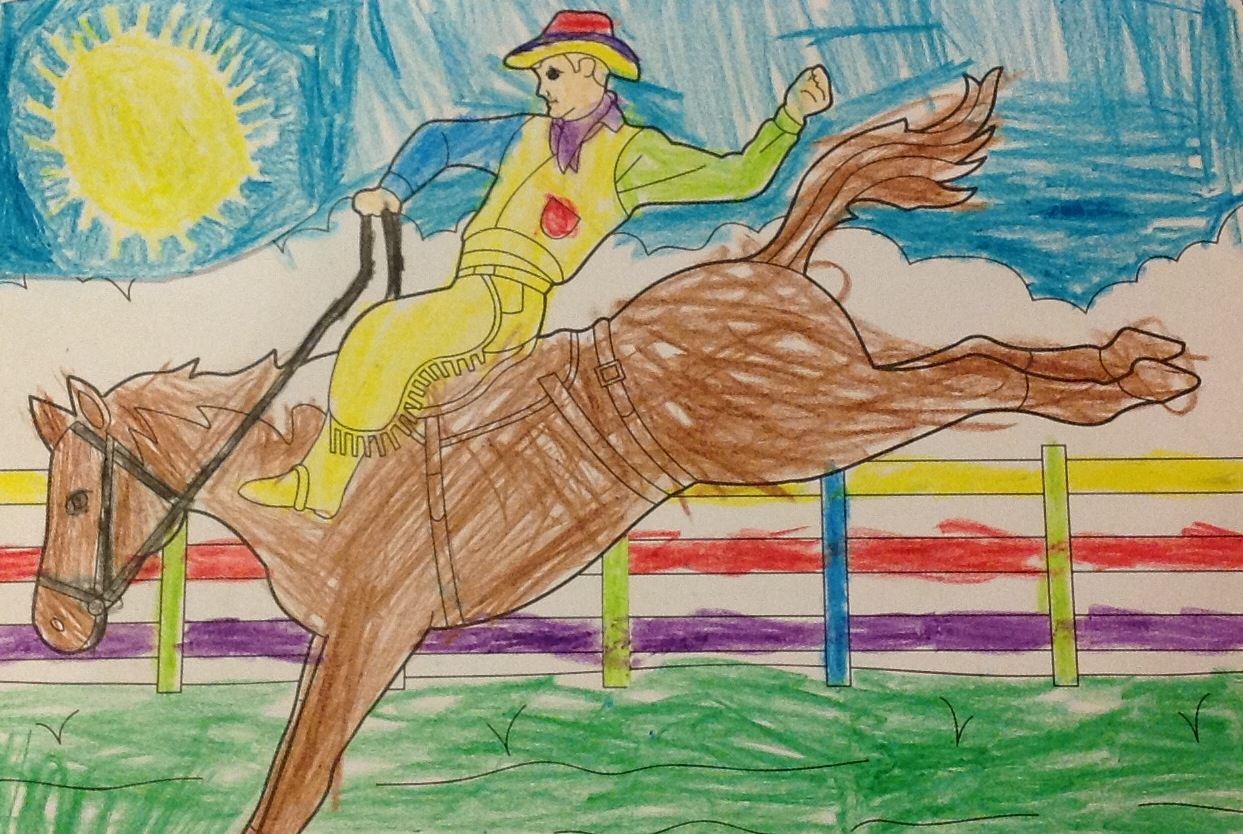
One afternoon this past weekend, he cleared some space at the kitchen table and asked me to sit with him while he colored. He chose a scene with a cowboy riding a horse, and worked carefully in crayon to make a sun in the corner of the page, complete with rays spreading out from a bright yellow center. I watched as he then colored a large swath of the sky, coloring blue right over the yellow sun. I wondered if he intended it that way, or if he was just caught up in the enjoyment of the blue. The answer came a moment later when I noticed him take a black crayon and make a scribble over and over the sun, and then slump back in his chair, dropping the crayon to the ground.

I thought this would fix it. It was supposed to be yellow, he said staring down at the sun, but I did the blue on it. I thought this would make it back to darker yellow, but it just ruined it.

He exhaled deeply and looked at me, then half-heartedly scraped with his thumbnail at the blue and black that covered his sun. The contentment that I had felt in sitting with him faded into sharing his deep disappointment.

What if we make it a cloud? I asked. It was the only thing I could think of.

Okay, he said.

I picked up the black crayon and traced an outline around the sun. There, now you color it in, and it will be a nice dark cloud.

He took the crayon from me and did just that. The black cloud looked a bit out of place in the otherwise bright blue sky, but he picked up a brown crayon and went back to coloring the cowboy riding his horse. I quietly exhaled in measured relief.

Until he started to cry.

But I wanted it to be a sunny day, Dad.

I was completely and utterly helpless. He had been enjoying our moment as much as I had; I was sure he had been enjoying the idea of his picture too, the image of it he held his mind. Now neither one was the way he wanted it to be, and there was nothing I could do about it.

Remembering his attempt to scrape away at the crayon, I thought of getting my wife’s sharp pair of sewing scissors to do the same, to reduce that paper to white, to give my son the fresh start he wanted.

Perhaps it was the scissors that gave me the idea of drawing a new sun on a separate piece of paper and pasting it on top of the mistake. I wasn’t sure he would like the idea, but he agreed and drew a new sun on a white piece of paper. He asked me to color in the blue so he wouldn’t go over the rays. I worked carefully and then had him finish before we glued it on. He was happy with it, and went back to the cowboy, the grass, and the fence.

Even though it turned out all right in the end, I can still hear him saying to me, through his sobs and tears, But I wanted it to be a sunny day, Dad. He had tried to set aside his disappointment – but he couldn’t. Instead, he surrendered to complete presence in the moment. No pretense, no holding back, no self-judgment. Isn’t that what we all long for?

Most touching as a father is that my son was willing to do this with me, and in this way expressed his complete love and trust. As an adult, experiencing and expressing anger, sadness, or disappointment in the presence of others is difficult for me. I have come to fear doing so.

Yet here was my five year old, showing me exactly how to do it right here, right now.

But I wanted it to be a sunny day, Dad.

Coda: In the days since, I have thought a lot about having fixed the drawing. I know I won’t always be able to give him the sunny day he wants. And I shouldn’t. But this one? I had to.

A Long-Forgotten Toy

Outside a robin hops
from a crusted snow pile
to the matted spring grass.

I stand at the window and watch,
while the echo of quiet play
mixed with soft humming
drifts out of the nearby bedroom
and into the hallway,

coming from a son
who is supposed
to be getting dressed —
but who has found absorption
in a long-forgotten toy.

I wish I could move
to see him,
but I don’t dare
stir the light
or sound the floorboards.

My body is warmed by the sun

before a shouted question
from downstairs intrudes
and the moment drains away.

Almost Eight

I stopped at the top of the stairs
to wait for him
as he shuffled out of his bedroom,
sleepy-eyed and not yet steady.

He took the old walnut railing
with his left hand
as we walked next to each other
towards breakfast and the day.

His right hand reached into mine,
gentle and soft,
warm from his blanketed slumber.

He’s almost eight years old, I thought,

in fear of the day
when he won’t slip so easily
into sharing his space
or his hand
with me.

I tried to tread carefully as we went
so as not to disturb our clasp,
wishing the stairs might go on forever,
a father and his boy.

The Spiral and The Path

DSC_0354_a
 
The fist time I made the spiral, I didn’t do it on purpose.

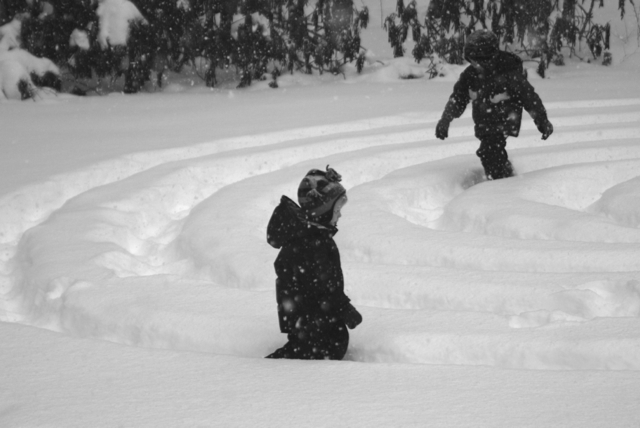
A few winters ago, I ran into the backyard after the first snow, and kept going until I had left a path of ever-smaller concentric circles. As will happen with snow, the path remained, and I walked back out along the same way. The kids, much younger then, noticed the design and enjoyed walking on it, too.

As much as being made of snow meant that the path wouldn’t disappear immediately, it eventually faded and was replaced by spring grass and flowers. Yet winter returns each year, and I anticipate the moment on the morning of the first snow of the season… Can we make the spiral, Dad?

Most years, subsequent snows pile on top but leave the pattern discernible underneath, and we walk it over and over to freshen the path to the inside. Other winters, the first snow melts away before the second one comes, and we have to remake the spiral several times over the course of a season. The kids will comment as the spiral disappears, You can still see it…but it will probably be gone by tomorrow.

A few years ago the snow was relentless, its crushing weight on the roof creating dams of ice that forced leaks into our nineteenth century windows. Over and over, I spent hours hours on a ladder, dangling precariously twenty-five feet up, spraying steaming hot water from a hose, melting away the damns. I would climb down the slippery ladder, encased in ice and exhausted, knowing the process would only have to be repeated in a few days time. The inner point of the spiral provided a respite at the end of this work; sitting seiza style in the bitter cold became easier than inside on my maple bench by the heater.

A couple of weeks back, my boys were running through this year’s spiral. We had recently gotten nearly three feet of snow in a storm, so it was tough going even though I had made the path smooth with snowshoes. The boys kept tripping and falling, laughing and shouting.

Be careful, I called.

That three feet of snow, of course, meant that I needn’t worry about them getting hurt. That would be impossible, and wasn’t why I had warned them to be careful. Instead, I was concerned about damage to the spiral.

Be careful.

The absurdity struck me before I finished saying it. The spiral comes and goes with the season and with the weather; it is the definition of impermanence.

Standing there, I knew the undisturbed edges and smooth path of the spiral aren’t real. They are simply my preferences, and aren’t likely to change anything, or to survive the transience of a path made out of snow – or survive the transience of this self I have grown attached to.

The spiral is beautiful after a fresh snow, when its lines are smoothed out. Just like my life, though, the spiral changes form, is disturbed, is re-created over and over, and inevitably disappears. Does it matter if it succumbs to a soft April morning or to my boys’ exuberance?

Buddhism and Zen urge us to practice renunciation, but this isn’t all about giving away our property or joining a monastery. It means letting go of preconceived notions and thoughts, of attachments to the ways we wish things were.

Like the spiral.

Letting go of the spiral, in fact, may open space to be more intimate with the path that is here today, right now. The one where my boys are tripping and falling, laughing and shouting. The one I am walking with my wife, with our children, the one with the rough edges and the sunshine, the snow and flowers, the sticks and the mud.

Refuge

I was tired, and my family was most of the way through dinner when I walked through the door. I would have only an hour to spend with the kids before they would go off to bed. I joined them at the table, anticipating stories about the day. Instead, I heard complaints about what had been prepared for dinner. Shortly afterward, calls to clean up blocks and legos brought tears. Short voices from children and adults alike arose from attempts to complete homework that had waited too long.

I needed refuge.

I looked for it in the memory of the night before, when I had lain down next to my five-year old son after tucking him into bed. There had been a few minutes left before our usual lights-out time, and he scooted to make room as I moved the spare pillow up next to his. He noticed that his older brother was reading in bed, and sensing an opening to keep me right where I was, grabbed a book of his own. He asked me about each of the pictures in the book of trains and made comments about which ones he liked best. He came to the end of the book and glanced at me, perhaps expecting I would get up to say goodnight. When I didn’t move, he leaned over the edge of his bed for another book.

It’s Go Dog Go, Dad. I’ll read it to you.

I watched him as he concentrated, listened as he matched the words to the pictures, rescued him when a page was just too tricky. The wind chill blew well below zero outside, but the room was hushed and I felt warm in the embrace of my son’s company. When it came time to turn out the light, he reached for a sticky note on the floor beside his bed.

For a bookmark, Dad. We can start there tomorrow night.

And so tonight, as everyone’s dissatisfaction with the present moment was apparent, I was desperate to climb back onto his bed, find that bookmark, and pick up right where we had left off. We struggled through the rest of the evening routine as best we could, then he and I flopped onto the bed, our book right where we had left it. He propped up his stuffed Eeyore doll under his arm – to help him read, he said – as I retrieved the spare pillow at the foot of the bed. We settled back to where we had been the night before.

My refuge disintegrated.

His reading was halting as he struggled with almost all of the words. I grew frustrated when, line after line, he encountered the word around, yet he somehow couldn’t read it. The phone rang and the light didn’t seem quite bright enough for reading. To my dismay, nothing felt the same. Page after page, I wanted the world to flow just as it had the night before. My attempts to help, to give us both that little nudge, couldn’t turn the calendar back a day. Time was passing too quickly, and each page too slowly. We picked a place to stop and I stood up to turn out the lights.

As I kissed him goodnight and walked across the room to my other son to stroke his cheek, I rested briefly in my frustration – and finally found my refuge. Right where it had been waiting for me all along, in the Buddha nature of the moment as it was, in the Buddha nature of my sons, in the Buddha nature of disappointment. Not in the memory of a moment gone by.

Standing there in that moment, I knew that by reaching back to try and recreate the night before, I had been trying too hard to take refuge. That’s what the vow says, after all – I take refuge in the Buddha, I take refuge in the Dharma. Perhaps it is a relic of translation from ancient Pali, or maybe just an unfortunate semantic coincidence, but there’s nothing there to be taken. As if refuge were something that I could grasp or a place that I could go.

How many times have I gone down that path?

Refuge, instead, finally came from letting go, from an acceptance of what was already there for me. And while refuge can find foundation in a vow and in the great determination of Yuanmiao or Hakuin, it blossomed tonight in the suddenness of resignation, finding purchase in the ceasing, for just a moment, of longing for something more. In openness and softness.

Both boys were asleep within moments as I headed downstairs to stand with my wife at the kitchen sink, where the dinner dishes still awaited.

Let me rest 
against your extra pillow,
the embroidered one 
from your crib years gone by,

while you lean back 
amongst the blankets
and read to me.

Go ahead and ask me
what each page says,
and tell me,
in your right-up-close voice,
which ones
are your favorite pictures.

Scratch the turning page
against the flannel sheets
until the very last one,

then offer me another reprieve.

Reach down to your
old apple-crate bookcase, 
and murmur to yourself
about which book
you might choose next.
A Son’s Gift

As we turned the corner in the grocery store, my five year old son walked a step ahead of me, clear about where he was going and full of intention.

Making trips to the grocery store isn’t my favorite activity, and the number of cars in the parking lot told of a large crowd inside – but I didn’t mind making this Christmas Eve outing. As we drove to the store, I watched my son clutch the dollar bill that he had pulled from the old tea container on his dresser, preparing to contribute it towards his big brother’s Christmas gift. I listened to the assured way he spoke, without revealing everything to me, about what he had decided to give to him.

He marched confidently most of the way down the toy aisle and stopped. This one, he said, pointing towards the shelf. I followed the direction of his hand and saw the blue box of eight matchbox cars. He pulled it from the shelf with both hands, bringing it to rest against his winter coat as he examined it closely, then turning towards me as I caught up, hopeful I would approve his choice.

It was the same gift his brother had gotten for him the year before. The same gift he had loved. I remembered him opening it Christmas morning, how he couldn’t imagine his good fortune at receiving a box of eight new cars, all at once. What could speak more clearly of his love for his brother than wanting to reciprocate, a year later, with the same?

Yet, as I stood there with Robin looking up at me, all that ran through my mind was how to get him to choose something else. His brother True is seven and a half, and hasn’t played a lot with cars and trucks in the last year. I knew he would be gracious in receiving the gift, but it seemed an awful lot of cars if he wasn’t going to spend much time with them. And at $12.99, well, it felt like a lot.

Let’s look around, I said, see what else is here. I suggested the small Lego sets that were in the same aisle – True loves Legos, doesn’t he? I suggested card games and even some smaller sets of cars. Robin dutifully obliged and examined that the alternatives I offered, but his heart wasn’t in it, and I knew it. I could feel the way the big set of cars pulled on him, even as we stood at each different shelf, motionless. He dismissed all the other options without words and returned back to pulled the box off the shelf. As he did, I thought I saw my opening in the form of a box just behind, a sort of combination track and ramp for matchbox cars that could be set up from a table to send cars flying. He’ll go for that, I thought, as I pointed it out it to him.

He looked, but didn’t take long. No, he said, I want to get this one for him.

He wasn’t demanding – just trying desperately to show me his sincerity, sincerity born from the warm feeling that still lasted from the previous Christmas, and his desire to share that with his brother, to get him the perfect gift, just like the extra large box of tea he had picked out for his mother.

Every bit of me could see that, could feel it, yet for some reason still struggled against it.

You don’t want this? I asked, holding up the track again. You could have races to see which of the cars you already have goes the farthest. I tried to paint a different picture than the one he had composed, the one he was holding dear. No, he replied, this one. Don’t we already have those cars? I flailed. No, he pointed out, these are different. He’ll love these.

There was nothing left for me to say. I could have flatly said no, that the set was too expensive. Or told him I didn’t think True really wanted eight new matchbox cars. But I couldn’t do either.

So instead I did something worse.

Continue reading

Saving All Beings

I was very late coming home from work last night – it was after 11 o’clock, and the whole family was asleep. I thought for a moment, as my wife turned over when I entered the room, that she might be awake in our bed, but she was quiet and still by the time I joined her. And so when I awoke this morning, I was anxious to see them all. I knew that the kids would have to run off to school soon and I would have to return to work, but I looked forward to the short time we had as I walked down the stairs.

Which made it all the more painful when, minutes later, I took the box of cereal from my son’s hand as he poured it, and sent him away from the breakfast table.

I would tell you that I long for simple moments of being with my children, times when notions and expectations drop away. I had just such an opportunity at the table this morning, as my boys found themselves possessed by silliness – each look from one brought the other practically to tears from laughter. Their voices rose as they called to one another, taking turns making faces just subtle enough to hold the expression for the few seconds it took to send his brother back over the edge. Knees knocked against the underside of the table as cereal squares spilled and milk droplets dripped off of their spoons.

I had the opportunity to witness and join them in this playfulness, this joy. Instead, I found myself simply wanting it to end. My body pulled back, my breath quickened. They laughed. I tensed. I told them that it wasn’t time to be silly and reminded them about their table manners. I sent them away.

I suppose there are legitimate reasons to help my children shape good table manners; in our relative world, they are important. But what am I teaching them about their laughter? And it goes beyond the table. My boys’ joy often finds its expression in moments that are loud and frenetic, unconstrained by any adult’s ideas about how it should look or sound. As they laugh and jump, as they delight in any noise they can make, they are meeting the world, living fully in what is offered. Unfiltered. Present.

In receiving the ten Grave Precepts of Buddhist practice, I vowed, recognizing that I am not separate from all that is, I vow to take up the way of not killing. This precept is often applied to the choice of whether or not we eat meat, or how we respond to a mosquito in the bedroom. But it also speaks to asking my boys to calm and quiet themselves, to experience and express their joy differently than the way in which they have found it. What dies then?

In receiving the Pure Precepts, I vowed to save all beings. But when I ask them to be something different because their expression of themselves is impeding the quiet I was hoping for, what does my response mean to them? What do they make of that experience when the world presents something so real, and their father tells them it isn’t right – not right now, not right here?

What am I teaching them about their laughter?

Back at the breakfast table this morning, I sat alone and wanting the moment, like many before it, to be different. Not because it was too noisy, but because it had now grown far too quiet. I went and spoke to my son and asked him back, telling him I knew he could use his best manners while he finished his breakfast.

At dinner later in the evening, he told me that he had tried to buy a gift for me at the school holiday fair. It was a baseball bat that was engraved with World’s Greatest Dad. He had seen it the day before and brought his money into school. I looked at him in silence for a moment as he finished telling me the story, about how they had sold out by the time he got there. I asked him to come sit on my lap. He had trouble sitting still, as still as I would have liked after another long day at work. But you can’t always sit still when you’re busy saving all beings. Or at least your Dad.

Fatherhood and the Five Remembrances

As a part of our sutra service at the temple, we regularly chant the Five Remembrances. Intended by the Buddha to ward off an impression of permanence in our current existence, these ancient words remind us that we are of the nature to die, and that we cannot escape separation from those who are dear to us.

It is stark reality – but it isn’t while chanting at the temple that I feel the weight of this realization.

Last night, in the brief interim between the frenzy of the day and the full silence of night, my wife and I were talking about our children. I commented about the way in which our youngest son had greeted me when I arrived home from work. He ran to me with a stack of coupons he had cut out of a junk mail flyer from the local warehouse store. We stood in the middle of the kitchen, the table being set, the oven opening and closing, his brother and sister whirling around us. He wanted to sit right there, right then, and show me. Later on, I wondered aloud to my wife about what had held him there. Was it the coupons themselves that he was so eager to share? Was it his pride in the careful cutting? Or was it just the chance be together, no matter what was at the center of it or what was going on around us?

My son is always reaching into my back pocket, looking for my phone to take pictures. He takes snapshots of crayon boxes, books on the floor, our feet together on a stool, cookies cooling on the counter, and toy dragons on windowsills. Pictures of each room, doorway, lamp, and family member. Hundreds of them at a time. It clogs the memory on my phone, and we try not to have our kids spend too much time with electronics. But I always give in when he asks. Each time I hear the shutter click, I feel his joy and his presence in that moment.

So when he was perusing and clipping these junk mail coupons earlier in the afternoon, my wife remembered, he had paused when he came across a camera. Could I get a camera, he asked her. She replied that maybe he should put it on his Christmas list. She showed me how his eyes brightened as he offered, Or maybe I should get a phone.

I could see his face in my mind as my wife finished this story and as I walked toward the kitchen to make the next day’s coffee. I could imagine his deep pleasure at the idea of having his own phone with which to take endless pictures. I reveled, as I reached into the cupboard, in how much I adore him.

Then, in the time it took to pull down the box of coffee filters from the second shelf, the warmth of that adoration was swiftly swallowed whole by the remembrance of change. My change, his change. The remembrance that I am of the nature to die, of the nature to be separated from him. From everyone. From everything. The feeling sank deep into my gut, an impossibly heavy mixture of sadness, anger, and confusion.

Some say the words of the Five Remembrances help them to live in the present moment. I didn’t have the sutra in mind then, but I did make an effort to stand in the kitchen and accept all that was being offered, that koan pulling deep inside me. Mostly, it was a moment filled with wanting desperately to go and wake up my son, to watch him walk about taking pictures, then sit closely and talk about the ones we liked best. Would it matter how tightly I held him?

The Five Remembrances

I am of the nature to grow old.
  There is no way to escape growing old.
I am of the nature to have ill health.
  there is no way to escape having ill health.
I am of the nature to die.
  There is no way to escape death.
All that is dear to me, and everyone I love, are of the nature of change.
  There is no way to escape being separated from them.
My deeds are my closest companions.
  I am the beneficiary of my deeds.
  My deeds are the ground on which I stand.

Coveted Space

My sons might be ignoring me
across the space of the kitchen and family room.

In the minutes that just passed,
they had shared only glaring complaints
and intrusions into coveted space
in the struggle to get teeth brushed
and clothes exchanged for pajamas.

Now they have settled next to each other,
one reclining deep into the corner of the couch,
slowly turning a page,
and pulling on a fingernail with his teeth;
the other kneeling up to the cushion,
working the pieces of a wooden box puzzle,
alternatively holding his breath and exhaling with concentration.

I’ve called them to bed
but can’t repeat myself.
The silence brushes my skin
as I stand absorbed and unmoving.